UWB: the new border in micro-geolocation for precision IoT
In the world of the Internet of Things (IoT), the question we hear most often is no longer ‘whether’ we can connect an object, but ‘where’ exactly that object is located. Whilst Bluetooth and Wi-Fi have dominated the connectivity landscape over the last decade, Ultra-Wideband (UWB) technology is rewriting the rules of indoor positioning.
At Omnetica, we design systems that demand absolute reliability. That is why UWB has become a cornerstone of our ‘sensing ecosystem’.
What is UWB and why is it a game-changer?
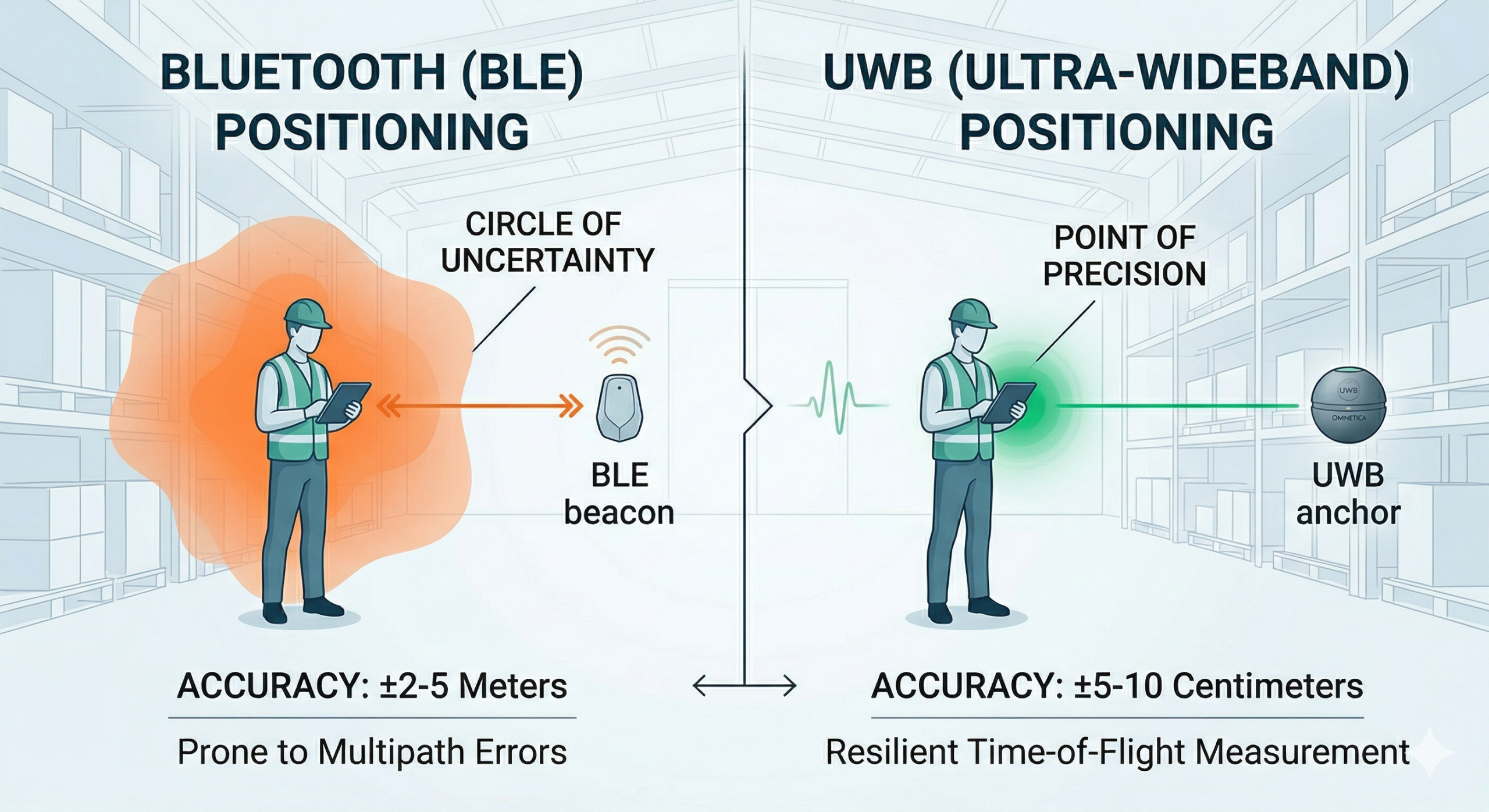
Unlike Bluetooth (BLE), which estimates distance based on signal strength (RSSI) — a method that is often inaccurate due to obstacles and interference — UWB uses Time of Flight (ToF).
The principle is mathematically simple but technologically revolutionary: the system measures the time taken for a radio pulse to travel from a transmitter to a receiver. Given that radio waves travel at the speed of light, the distance is calculated with extreme precision, enabling positioning accuracy of around 5–10 centimetres, compared to 2–3 metres with traditional technologies.
The 3 Pillars of UWB Technology for Industry
Why should a company integrate UWB into its production processes or products?
1. Centimetre-level accuracy in real time.
In an automated warehouse or on a production line, knowing the ‘approximate’ location of an asset is not enough. UWB enables real-time tracking (RTLS) with minimal latency, making it possible to navigate autonomous robots and manage stock with millimetre precision.
2. Immunity to interference
UWB operates across a very wide frequency band (from 3.1 GHz to 10.6 GHz). This means it does not ‘clog up’ already saturated corporate Wi-Fi networks and, thanks to the short duration of its pulses, is extremely resilient to the so-called ‘multipath effect’ (signal bounces off metal walls).
3. Unrivalled security
Thanks to time-of-flight measurement, UWB is immune to ‘relay attacks’. It is virtually impossible to deceive the system by simulating proximity that does not exist, which is why leading automotive brands have chosen it for their next-generation digital keys.
Practical applications: where UWB makes a difference
Designing an IoT solution is not just about choosing a chip, but about integrating UWB into a functional ecosystem. The applications we are working on include:
- Workplace Safety: Human-machine collision prevention systems. If an operator gets too close to moving machinery, the UWB sensor detects them and shuts down the system instantly.
- Smart Retail & Museums: Creating interactive experiences based on the visitor’s exact position in front of a work of art or a shelf.
- Logistics 4.0: Monitoring material flow to eliminate bottlenecks in picking processes.
- Smart Home: Systems for activating sensors and unlocking locks via proximity.
Omnetica's touch: bespoke sensors
At Omnetica, we don’t believe in ‘one-size-fits-all’ solutions. UWB technology offers enormous potential, but requires hardware and software calibration tailored to the specific environment in which it will operate.
Our data collection systems are designed to translate UWB radio pulses into actionable insights: intuitive dashboards, efficiency reports and real-time alert systems.
The future lies in precision.
Do you have a project that requires going beyond the limits of standard geolocation? The Omnetica team is ready to design your bespoke UWB sensor network.