In the IoT (Internet of Things) landscape, one of the most complex challenges is efficiently and securely connecting remote devices while minimizing energy consumption. This is where LoRa (Long Range) technology comes into play, specifically designed to enable wireless communication over long distances at low speed and with reduced power consumption.
What is LoRa?
LoRa is a proprietary radio modulation technology developed by Semtech, based on spread spectrum modulation, more precisely Chirp Spread Spectrum (CSS). Unlike traditional digital communication (FSK, GFSK, etc.), CSS allows for more robust communication against interference and noise, improving range even in challenging environments.
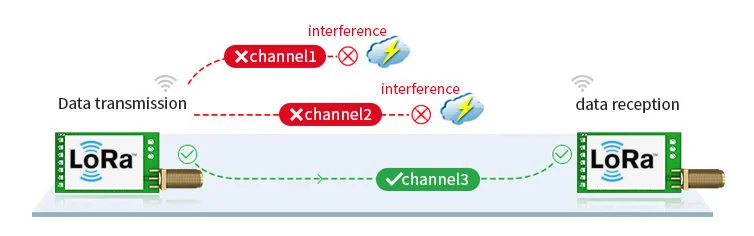
Network Architecture
A typical LoRa setup is based on a LoRaWAN network, where nodes (sensors or actuators) communicate with one or more gateways that forward messages to a central server. However, it is also possible to create peer-to-peer (LoRa RAW) networks for custom applications, for example between ESP32, Arduino, or STM32 microcontrollers.
Why LoRa for distributed sensors?
Applications such as environmental monitoring, precision agriculture, forest management, remote infrastructure control (like aqueducts or gas pipelines), or rural alarm systems require:
- Extended range (up to 15–20 km in open field, and potentially much more with proper setup)
- Asynchronous and intermittent communication
- Minimal power consumption for battery-powered devices
- Resistance to electromagnetic interference and natural obstacles
In all these scenarios, LoRa proves to be a winning solution.
Complementary Technologies
1. FEC – Forward Error Correction
Advanced error correction (FEC) allows the receiver to reconstruct data even in the presence of transmission errors, increasing reliability. Using Hamming coding or similar techniques, LoRa packets maintain integrity even at the edge of radio range.
2. LBT – Listen Before Talk
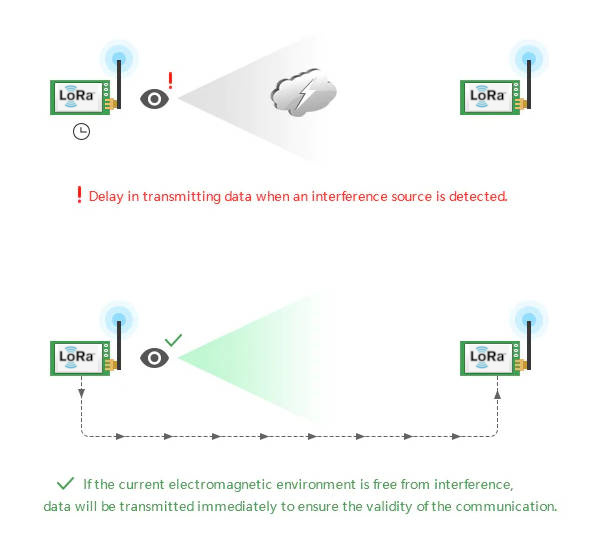
Some LoRa modules feature LBT, which checks whether the radio channel is free before transmitting. This prevents collisions in high-traffic environments and improves coexistence among devices.
3. Wake-Up Radio
To further reduce power consumption, some applications use an ultra-low-power secondary radio to “wake up” the main module only when needed. This is useful in scenarios where the node must listen for long periods without transmitting.
4. Ultra-Low Power Design
Using microcontrollers with advanced sleep modes (such as STM32L or ATMega328P in deep sleep) and selecting optimized LoRa modules (LLCC68) enables months or even years of battery life, even with a single Li-Ion battery or a solar cell.
Use Cases
🧑🌾 Smart Agriculture
- Soil moisture and temperature sensors connected via LoRa to a central node
- Remotely activated automated irrigation systems
- Detection of intrusions or anomalies (movement, gate opening, etc.)
🌲 Large Area Monitoring
- Compact weather stations in a distributed network
- Forest fire monitoring using smoke/temperature sensors
- Anti-poaching systems with PIR sensors and LoRa P2P
Conclusion
LoRa technology is an outstanding tool for developing distributed sensor systems, especially in large areas not covered by cellular infrastructure and where autonomy is a priority.